Blog · Inspiring Côte d'Azur

Auguste Renoir: When the French Riviera Became a Source of Inspiration

Sandra Ottaviani guide conférencière d'Inspiring Côte d'Azur
About the author
Sandra Ottaviani

Founder of Inspiring Côte-d'Azur

For over 30 years, Sandra has been exploring the French Riviera and neighboring Italy in search of authentic places, hidden gems, and meaningful encounters.

She shares a sincere, elegant Riviera, far from the clichés.

When we think of the French Riviera, we naturally picture its sun-drenched landscapes, Mediterranean gardens, hilltop villages and that unique light that has attracted artists from all over the world. Among them, Auguste Renoir holds a very special place. A leading figure of Impressionism, the painter chose to settle in Cagnes-sur-Mer, in the hills overlooking the French Riviera, towards the end of his life. Here, far from the hustle and bustle of Paris, he found an environment that continued to inspire his work and profoundly influenced the way he viewed light, nature and the human body.

Even today, his legacy remains deeply connected to the area. To discover Renoir on the French Riviera, simply visit the Domaine des Collettes, his final home, which has since been turned into a museum. Visitors can still experience the atmosphere in which the artist lived, painted and welcomed his family and friends. It is an essential stop for anyone wishing to understand the connection between Renoir and the French Riviera.
Auguste Renoir, One of the Great Masters of Impressionism

Born in Limoges in 1841, Pierre-Auguste Renoir moved to Paris with his family while he was still a child. Drawn to the arts from an early age, he began his career as a porcelain painter before devoting himself fully to painting. He later became part of Paris’s artistic circles and took part in the first Impressionist exhibition in 1874.

Alongside Claude Monet, Alfred Sisley, Camille Pissarro and Édouard Manet, Renoir helped transform French painting. The Impressionists sought to portray the world as they perceived it, focusing in particular on variations in light and colour. In Renoir’s work, this approach resulted in remarkably luminous paintings, in which everyday scenes, portraits, landscapes and the human body played an essential role.

Among his most famous paintings are The Swing, Young Girls at the Piano and his many depictions of bathers. His style evolved throughout his career: the Impressionist brushstrokes of his early years gradually gave way to more defined forms and a stronger classical influence.

But it was in the south of France that his artistic world took on a new dimension. In search of a milder climate, Renoir regularly stayed on the French Riviera, particularly in Cagnes-sur-Mer and Nice. The Mediterranean sunshine, olive trees and landscapes of the Nice region gradually became essential elements of both his daily life and his work.

Renoir in Cagnes-sur-Mer: Les Collettes, His Refuge on the French Riviera

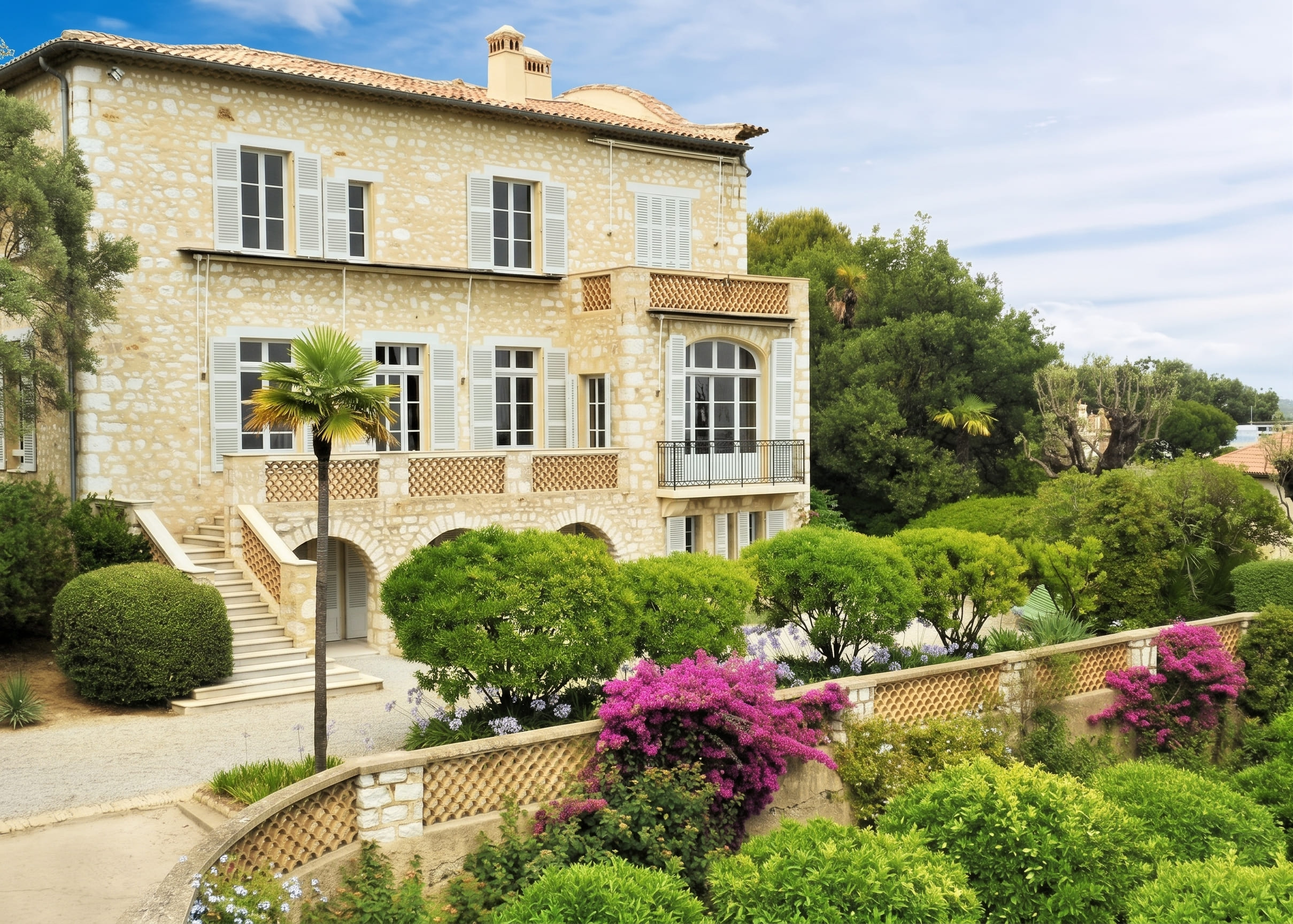
In 1907, Auguste Renoir purchased the Domaine des Collettes in Cagnes-sur-Mer. He had a house built there, surrounded by a large garden planted with olive trees. The estate became his true refuge and one of the most important places of his final years.

Today, when visiting the Renoir Museum in Cagnes-sur-Mer, it is easy to imagine the painter sitting in his studio, observing the vegetation and light surrounding his home. The Mediterranean landscape was no longer simply a backdrop: it became a genuine source of inspiration.

Renoir painted numerous portraits and nudes there, as well as scenes directly inspired by his surroundings. The Bathers, painted between 1918 and 1919, are among his final major works. The models posed in the garden at Les Collettes, surrounded by olive trees. The Musée d’Orsay has highlighted the importance of this Mediterranean landscape in Renoir’s work, associated by the artist with an almost paradisiacal vision of nature.

Even as he was increasingly affected by illness and physical difficulties during his final years, Renoir continued to paint. His time in Cagnes-sur-Mer was therefore far more than a simple retirement: it was a particularly productive period in his artistic career.

The estate also offers an insight into the artist’s family life. His son Jean Renoir, who would later become one of the great directors of French cinema, grew up partly in this environment. The relationship between the painter father and the filmmaker son would become particularly fascinating in the years that followed.

Following in Renoir's Footsteps: An Artistic Walk Through the Heart of the French Riviera

Today, following in Auguste Renoir’s footsteps is a wonderful way to discover another side of the French Riviera. Beyond its beaches and seaside resorts, the region has a rich artistic history, shaped by painters who came here in search of a different kind of light.

In Cagnes-sur-Mer, a visit to the Domaine des Collettes is undoubtedly the essential stop. The house preserves the atmosphere of the place where Renoir lived until his death in 1919. The museum allows visitors to discover his world, his studio and his everyday surroundings. Several works connected to Renoir can also be found there, including The Large Bathers.

But Renoir’s connection with the French Riviera does not end at Les Collettes. The painter also spent time in Nice, where some of his works were exhibited during the 20th century. Seated Young Girl, for example, was presented in various exhibitions dedicated to Renoir in Nice.

For me, this is precisely what makes his story so fascinating: when walking through the Nice region today, you can try to look at the landscape through the eyes of an artist who saw much more than just a backdrop. The light falling on the façades, the olive-tree gardens and the hills surrounding Cagnes-sur-Mer… everything that makes the French Riviera so charming today also helped shape Renoir’s imagination.

Auguste Renoir died in Cagnes-sur-Mer in December 1919, at the age of 78. More than a century after his death, however, his legacy remains very much alive. By visiting Les Collettes, discovering his paintings or simply exploring the landscapes of the Nice region, it becomes clear why this part of France inspired so many artists.

Renoir on the French Riviera is ultimately a story of light, colour and Mediterranean landscapes. It is a reminder that the French Riviera is not just a destination: it is also a land of artists, where the beauty of the landscape continues, even today, to inspire those who take the time to truly look at it.

Sandra Ottaviani guide conférencière d'Inspiring Côte d'Azur
About the author
Sandra Ottaviani

Founder of Inspiring Côte-d'Azur

Passionate about a region she knows like the back of her hand, Sandra has been criss-crossing the roads of the Côte d'Azur and neighboring Italy for over 30 years in search of authentic places, secret addresses and human encounters.

Thanks to her experience in tourism and her curious eye, she shares her inspirations here to help you discover a Riviera that's sincere, elegant and far from cliché.

· Our Latest Articles ·

Travel Inspirations: A Different Way to Experience the French Riviera ?

Private Chauffeur VTC Service Available Year-Round on the Côte d’Azur and in Northern Italy
Comfortable Transfers From Nice, Cannes, Monaco, Genoa, Milan, and More.