Blog · Inspiring Côte d'Azur

Marc Chagall: From Vitebsk to Saint-Paul-de-Vence, a Journey Between Memory and LightMarc Chagall: From Vitebsk to Saint-Paul-de-Vence, a Journey Between Memory and Light

When speaking about Marc Chagall on the French Riviera, we are not simply talking about a painter who settled in the South of France. We are talking about a man who crossed borders, survived wars, endured exile, and ultimately found a sense of inner peace here.

Marc Chagall was born in 1887 in Vitebsk, a small town in the Russian Empire that would leave a profound mark on his entire body of work. Vitebsk was not merely the backdrop of his childhood; it became a world of its own, filled with memories, Jewish traditions, everyday scenes, snow-covered rooftops, and floating figures that would repeatedly reappear throughout his paintings.

One thing I enjoy telling visitors is that Chagall never truly left Vitebsk in his mind. Even while living in Paris, later in exile in the United States, and eventually back in France, the town continued to exist in his art. It became an imaginary place, almost mythological. In a way, the French Riviera would later play a similar role: a real territory that also became an inner landscape.

After the upheavals of the twentieth century, particularly war and exile, Chagall returned to France and eventually settled permanently in the South. There, he found a stability he had not experienced for many years. More importantly, he discovered a different pace of life, a gentleness and a light that would accompany him until the end of his life.
The Marc Chagall National Museum in Nice: Entering an Inner World

In Nice, the Marc Chagall National Museum is a place I particularly enjoy introducing to visitors. It does not feel like a conventional museum. There is something calm and almost meditative about it, as though one were entering a separate world.

The heart of the museum is dedicated to the Biblical Message, a monumental series inspired by stories from the Old Testament. Even without any religious background, visitors are immediately struck by the visual power of the works.

The scenes are never static. The figures seem to float and move through space, suspended somewhere between earth and sky. It is a highly personal and instantly recognizable artistic language.

What often moves visitors most is the feeling that every painting tells something deeply intimate. Rather than confronting cold or distant works of art, they encounter memory transformed into images.

The museum itself was designed in collaboration with Chagall. He wanted it to be a simple, luminous space dedicated to contemplation. Even today, that intention can still be felt in every room.

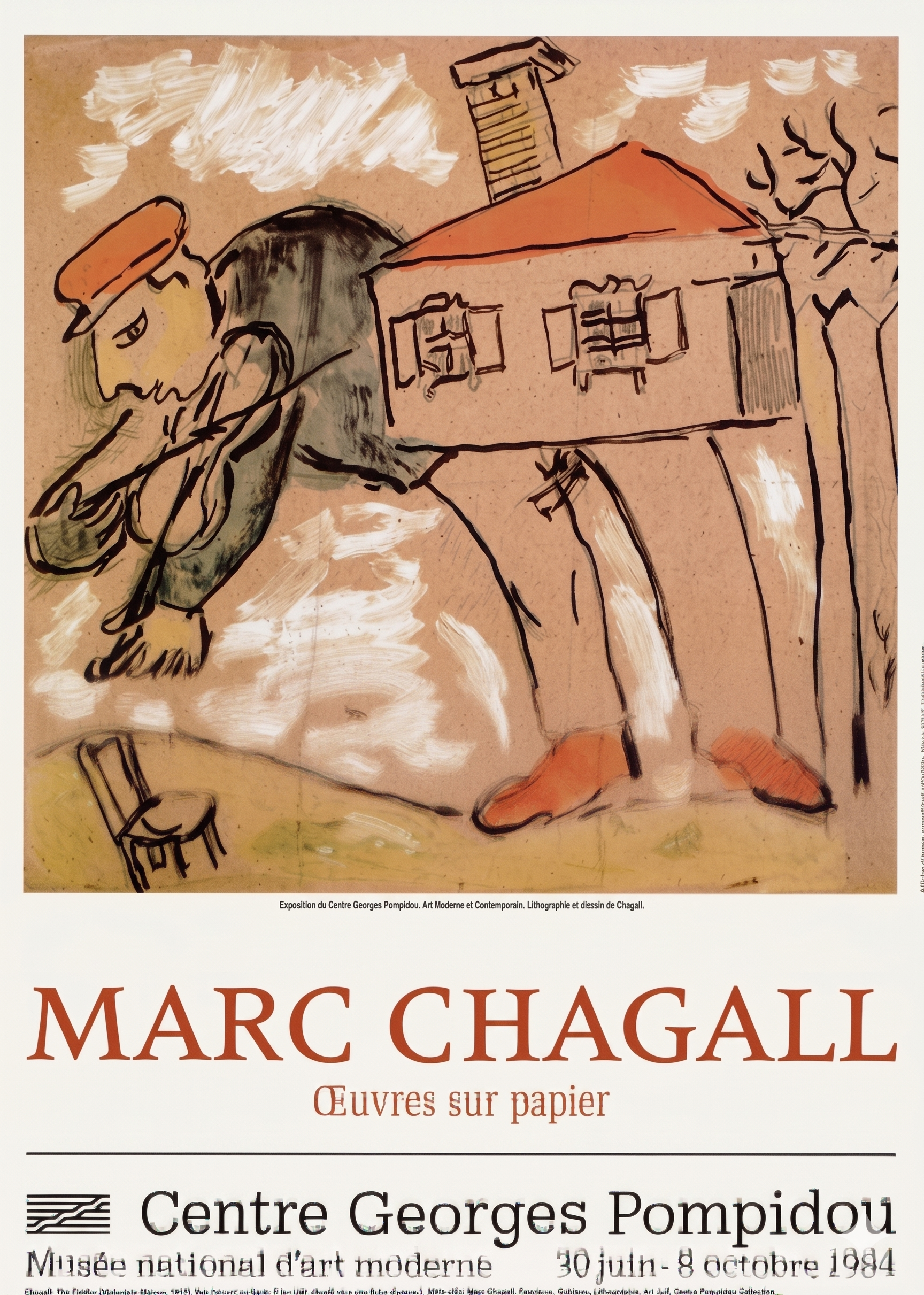
Affiche de Marc Chagall

Saint-Paul-de-Vence: Chagall’s Final Light

The final important chapter of Chagall’s life can be found just a few kilometers from Nice, in Saint-Paul-de-Vence. This hilltop village, surrounded by ancient ramparts, became a haven for many artists over the years, but it holds a particularly special place in Chagall’s story.

It was here that he spent the last decades of his life. And when walking through the narrow streets of Saint-Paul-de-Vence, it is easy to understand why. There is a remarkable harmony between the stone buildings, the Mediterranean light, and the surrounding landscape. Everything seems suspended in time.

Chagall lived a peaceful life here, far from the bustle of the great artistic capitals. He continued to create while surrounded by an atmosphere that deeply resonated with him.

Today, Saint-Paul-de-Vence still retains this strong artistic identity. Its galleries, artists’ studios, and the renowned Fondation Maeght all reflect the village’s rich cultural heritage.

Most importantly, this is where Marc Chagall now rests. He is buried in the cemetery of Saint-Paul-de-Vence, the village he chose for the final years of his life. It is a simple and peaceful place, surrounded by greenery, reflecting the man he had become in his later years.

A Legacy Between Vitebsk and the French Riviera

To speak about Marc Chagall is to tell the story of a journey between two worlds: Vitebsk, the city of his origins and the foundation of his imagination, and the French Riviera, where he found serenity and artistic continuity.

His work connects these two places as though they were one. On one side stand memory, exile, and roots. On the other, light, tranquility, and the creativity of his later years.

By the end of a visit to Nice or Saint-Paul-de-Vence, one realizes that Chagall never truly left his inner worlds behind. He simply transformed them into colors, floating figures, and visual poetry.

Today, his legacy remains deeply present on the French Riviera. Every place associated with his life tells, in its own way, the story of this extraordinary journey between Vitebsk and the Mediterranean.

Sandra Ottaviani guide conférencière d'Inspiring Côte d'Azur
About the author
Sandra Ottaviani

Founder of Inspiring Côte-d'Azur

Passionate about a region she knows like the back of her hand, Sandra has been criss-crossing the roads of the Côte d'Azur and neighboring Italy for over 30 years in search of authentic places, secret addresses and human encounters.

Thanks to her experience in tourism and her curious eye, she shares her inspirations here to help you discover a Riviera that's sincere, elegant and far from cliché.

· Our Latest Articles ·

Travel Inspirations: A Different Way to Experience the French Riviera ?

Private Chauffeur VTC Service Available Year-Round on the Côte d’Azur and in Northern Italy
Comfortable Transfers From Nice, Cannes, Monaco, Genoa, Milan, and More.
Legal Notice Politique de confidentialité Terms and Conditions of Sale
© 2026 · Inspiring Côte-d'Azur · Tous droits réservés