Blog · Inspiring Côte d'Azur

The Blue Chair of Nice: A Timeless Symbol of the Promenade des Anglais

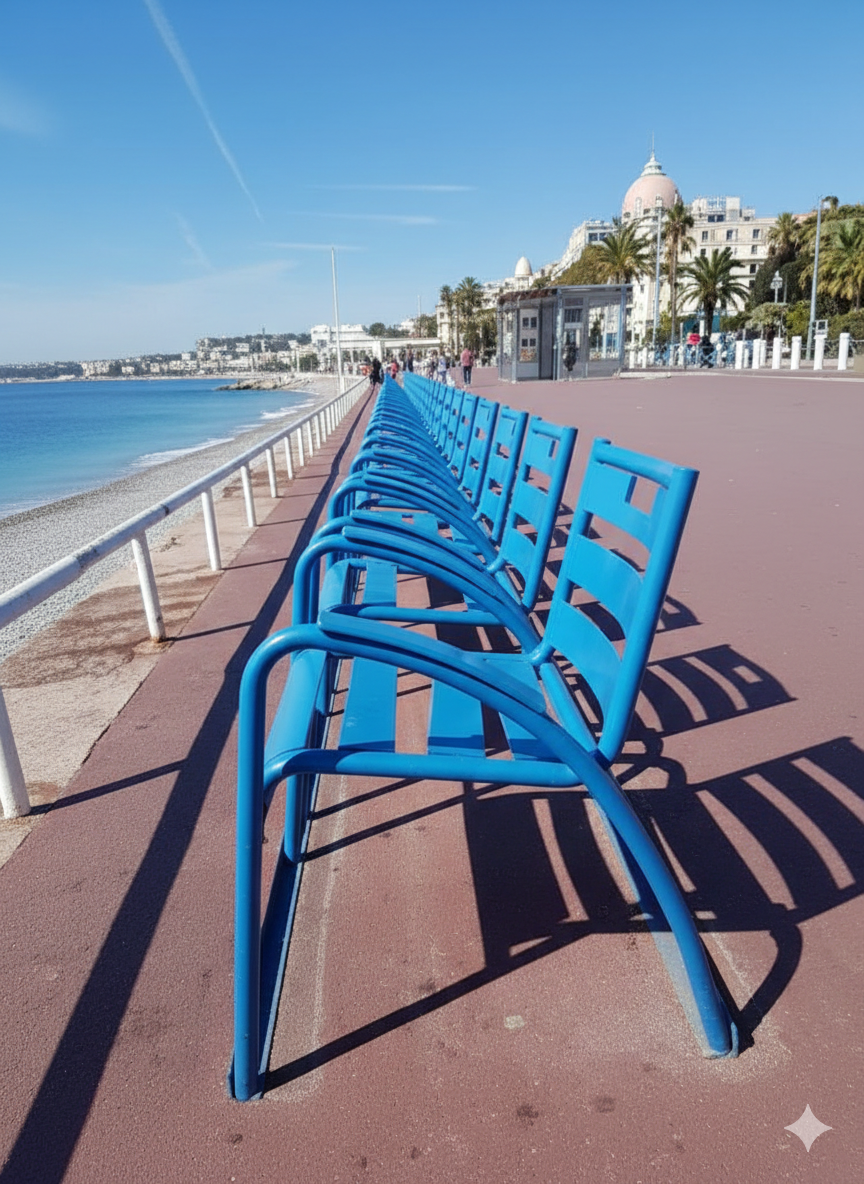
When one thinks of Nice, it’s impossible not to picture the famous blue chairs lining the Promenade des Anglais. Featured on nearly every photograph, postcard, or souvenir item from the city, they embody the spirit and unique charm of the French Riviera. These chairs are more than decorative elements; they reflect a tradition deeply rooted in the daily life of both locals and visitors. They invite relaxation, contemplation, and sharing, offering everyone a small corner with a view of the Mediterranean Sea.

These iconic chairs can be found all along the Promenade des Anglais, on the beach, near gardens, and under the palm trees that line the famous avenue. But behind their elegance lies a true story, one of Niçois ingenuity and craftsmanship passed down through generations. They are a living symbol of the city, as if each chair tells a piece of Nice’s life.
From Origins to the Invention of the Fauteuil Ballanger

The story of the blue chairs begins after World War II, around 1948, when Jacques Ballanger, holder of the municipal maritime furniture concession, decided to replace the old wicker chairs, which were deemed too fragile. His goal was ambitious: to manufacture 800 sturdy chairs capable of withstanding daily use by visitors along the Promenade des Anglais. At that time, people had to pay to sit: the “chaisière” issued a ticket granting the right to take a seat, much like a receipt.

To accomplish this project, Ballanger enlisted Charles Tordo, a native of Tourrette, renowned for his ingenuity, numerous patented inventions, and artisanal skills. Employed at a railway maintenance company run by Michel, Tordo dedicated his evenings and Sundays to his workshop—an old mule stable—to design this new furniture. Together, Ballanger and Tordo created the Fauteuil Ballanger, a strong, practical, and aesthetically pleasing model that would become the famous blue chair of Nice.

The chair was designed to withstand outdoor conditions and underwent numerous improvements over time: reinforced crossbars, TRCC stainless steel bolts, cataphoretic paint, and polyester lacquer. Between 1950 and 1970, nearly 10,000 chairs left Tordo’s workshop—blue for the seaside in Nice, white for public gardens—symbolizing the adaptation of furniture to different urban spaces. The blue chair was therefore more than just a practical object: it represented the combination of modern design, durability, and local ingenuity.

Chaise bleue

A Chair Symbolizing Niçois Hospitality and Heritage

Today, the blue chairs of Nice are no longer just functional objects; they have become a true symbol of the city. Their vibrant color evokes the Mediterranean Sea, while their regular presence along the Promenade des Anglais reminds visitors and locals alike that history and tradition blend seamlessly with the pleasure of strolling and enjoying the scenery.

They also embody Niçois conviviality. Each chair invites people to sit, chat with a neighbor, read a book, or simply watch the comings and goings of passersby. Both locals and tourists have learned to appreciate this urban furniture, which makes the promenade accessible to everyone, providing a relaxing space without distinction of class or status.

For lovers of Nice, sitting on a blue chair is no trivial gesture: it’s a small ritual that allows one to feel the city’s soul, connect with its history, and share a moment of serenity in a remarkable setting. These chairs are far more than furniture: they are an invitation to discover Nice differently, to take time, and to soak in its unique atmosphere.

Sandra Ottaviani guide conférencière d'Inspiring Côte d'Azur
About the author
Sandra Ottaviani

Founder of Inspiring Côte-d'Azur

Passionate about a region she knows like the back of her hand, Sandra has been criss-crossing the roads of the Côte d'Azur and neighboring Italy for over 30 years in search of authentic places, secret addresses and human encounters.

Thanks to her experience in tourism and her curious eye, she shares her inspirations here to help you discover a Riviera that's sincere, elegant and far from cliché.

· Our Latest Articles ·

Travel Inspirations: A Different Way to Experience the French Riviera ?

Private Chauffeur VTC Service Available Year-Round on the Côte d’Azur and in Northern Italy
Comfortable Transfers From Nice, Cannes, Monaco, Genoa, Milan, and More.